Preserve or Progress
I find it fascinating how quickly humanity is moving into the next industrial age. A lot has been written lately about AI as the next layer of the web. I think we're leaping right past Web 3.0, and this is something out in the future: Web 4.0. I'd go broader and just call it technology, because technology is the engine of human intelligence and human productivity.
My economic outlook is simple: going forward, there is only one sector, and it's technology. I'm not here to argue about how the markets classify industries. My point is that whatever you make, you compete on technology. Take a woodworker building furniture entirely by hand. The artisan can't be replaced, but everything the artisan touches (harvesting, shipping, tooling) is better than it was a decade ago, and that shows in the work.
So I'm 100% in favor of building the infrastructure for this age. It isn't us versus them. We still have flags and borders and tribes. But this is a step-change for humanity. The optimist in me hopes that a hundred years from now, this era is taught as the one where we started to put down our individual flags and stand under one representing the human race. Starfleet is a ways off. This might be the genesis, though, and it begins with tremendous processing power.
Preserve or progress
Data centers are a divisive topic. Honestly, I don't think we're building enough of them. Yes, communities will be affected and ways of living will change. No, no decision here is consequence-free. But the two sides aren't conservative and liberal. They are preserve and progress.
There has always been a chorus urging caution, and there always will be. Look at the long view, though, and progress doesn't stop. We can't not be what we are: builders, explorers, thinkers, dreamers. I'm fine with the double negative.
Look at the map
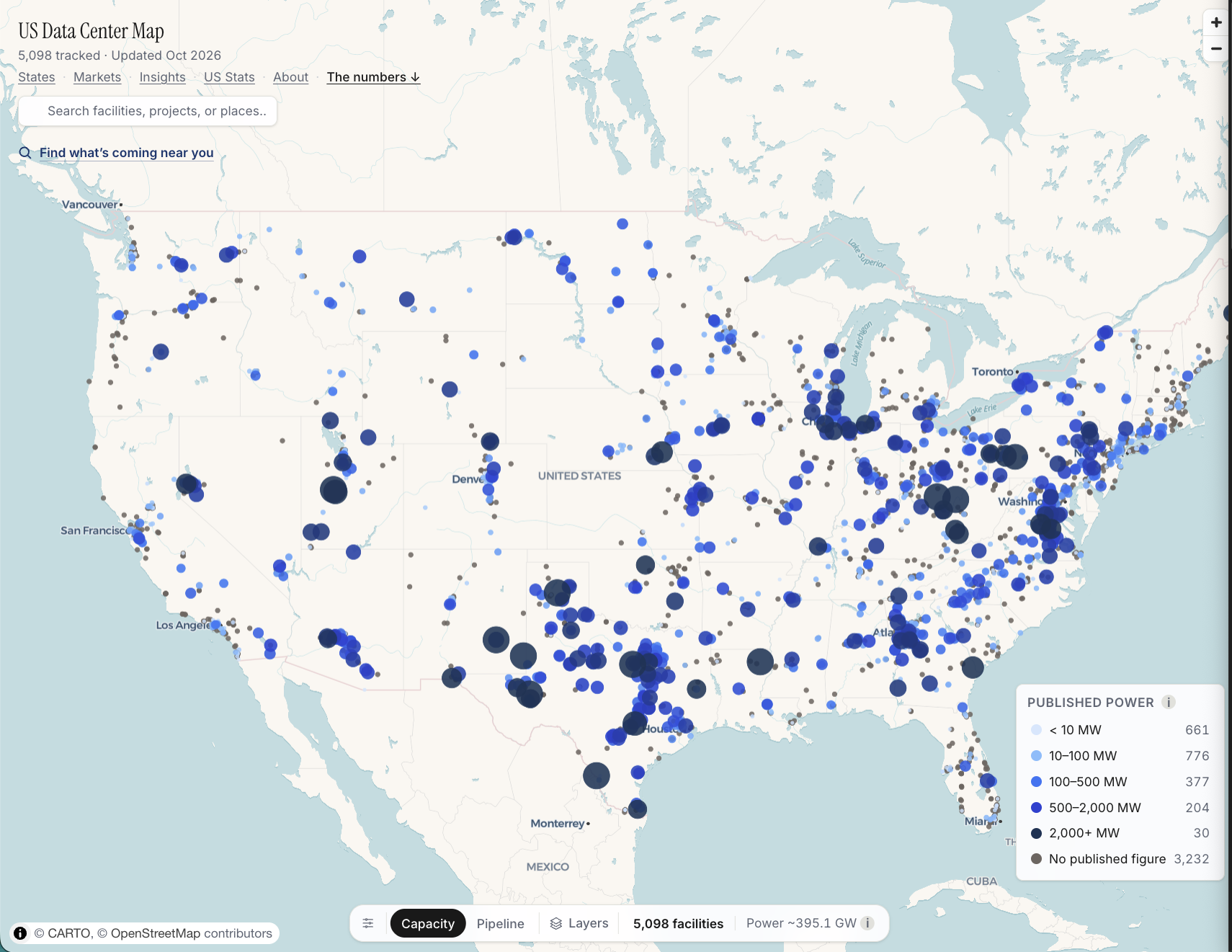
Source: dcmap.us, a live US data center map worth exploring yourself.
Look at the progress being made. That map tracks 5,098 US data center facilities and projects. About 49 GW is operating today, 69.6 GW is under construction, and another 276 GW is planned.
Then zoom in. A gigawatt is instantaneous demand, the power a facility draws at a given moment, and individual campuses are now being planned in excess of 15 GW. In the Texas Panhandle, Fermi America's Project Matador campus is planned at 17 GW, with early site and generation work underway.
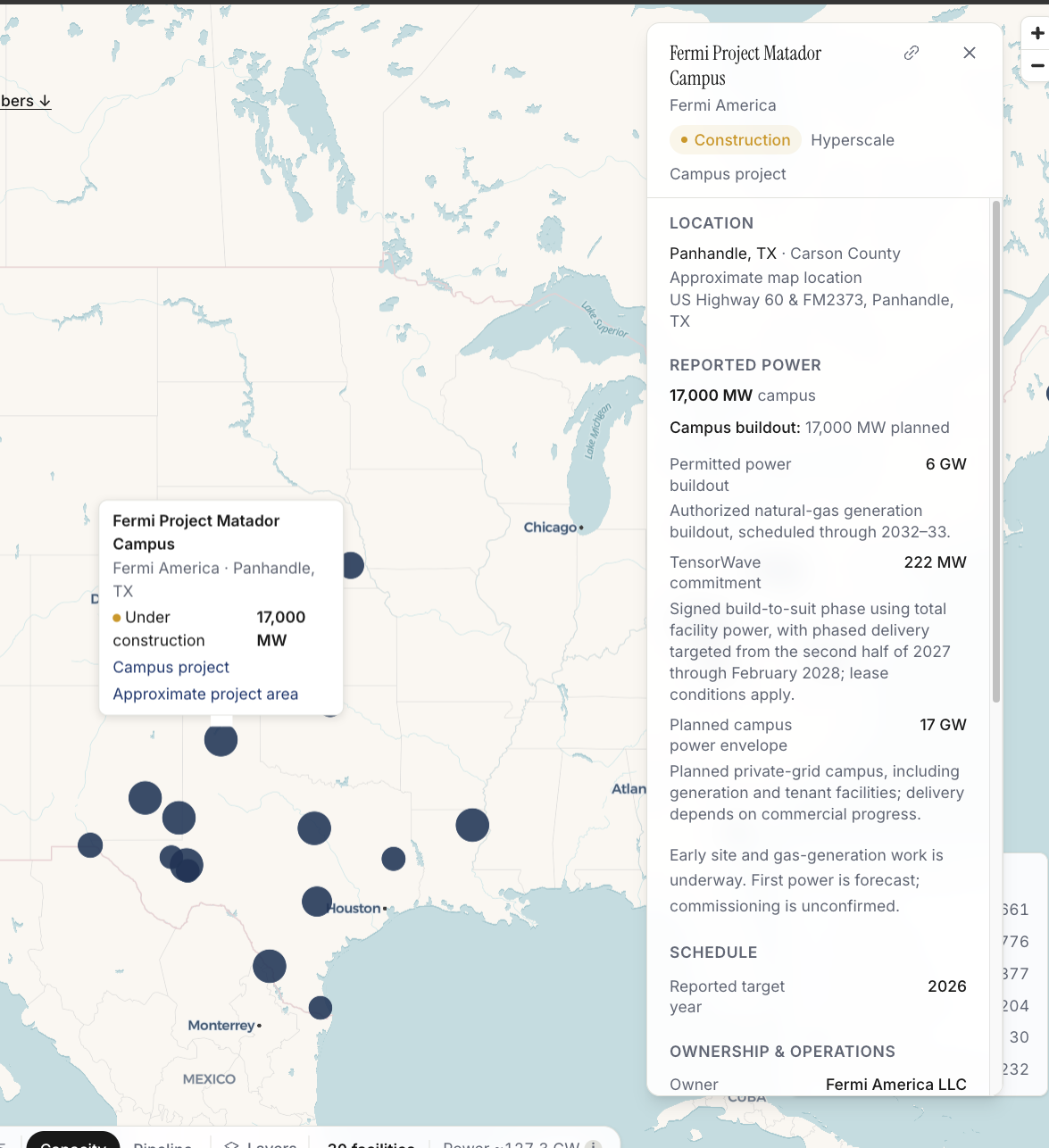
To put one campus in perspective: London draws roughly 6 GW at any moment and Dallas roughly 11 GW. Tokyo is the giant at somewhere between 45 and 64 GW. A single campus planned at 17 GW would outdraw London and Dallas combined. And since I'm a Kiwi at heart, here's one closer to home: in a cold snap this August, all of New Zealand hit a record peak of about 7.4 GW (that's Transpower's number). One planned campus in Texas is more than twice that. While these numbers are enormous, it's comforting to know that humans have done this before, approximately, and we'll do it again.
How the grid is adapting
I dug into how the electrical grid is being redesigned for this step-change. Four ideas stood out.
1. Direct high-voltage interconnection. Campuses at this scale skip the local distribution lines and connect straight to high-voltage transmission (typically 345 to 500 kV in the US). Operators build private on-site substations to step the voltage down. The wires feeding nearby neighborhoods never carry the load.
2. Behind-the-meter generation. Some campuses build their own power next door. Big tech companies have signed deals with nuclear startups for small modular reactors that provide steady baseload. Others run clusters of natural gas turbines that can carry the site when the public grid is stressed or congested.
3. Co-location with existing plants. Rather than asking the grid to haul power to a data center near a city, developers are building next to nuclear plants and big hydro dams. Plugging into the plant's switchyard means the gigawatts never cross public transmission lines, so there is less strain on the grid.
4. Advanced transmission technology. New towers take years of approvals, so utilities are upgrading the lines they already have. High-temperature low-sag conductors use composite carbon cores and can carry up to twice the current without sagging into trees. Dynamic line rating uses sensors for wind and temperature, so a windy day (which cools the lines) allows more power through instead of a conservative fixed limit.
None of this is free of tradeoffs. But it is what progress looks like when it's actually happening.